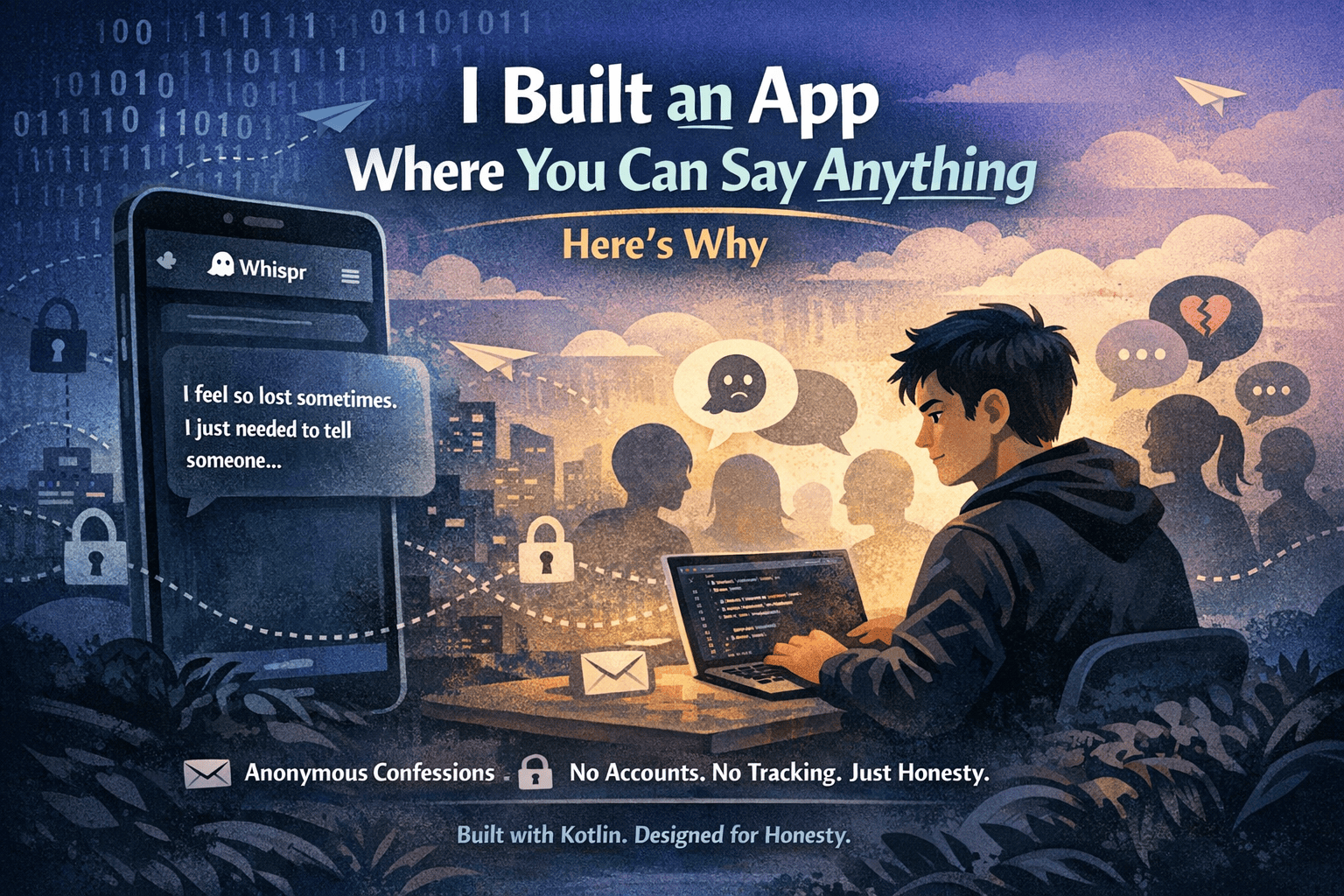
There's a conversation most of us have never had. Not because we don't want to have it, but because we don't know how to start it. Maybe it's something you did that you're not proud of. Maybe it's a feeling you've been carrying alone for months. Maybe it's just a thought that would sound strange coming from your mouth, attached to your name, in front of people who know you.
I've been there. Most people have. And that's exactly why I built Whispr.
The Problem With Having a Name
Here's something interesting about human psychology — people are fundamentally more honest when they're anonymous. This isn't a new observation. Research in behavioral science has shown for decades that anonymity removes the social pressure that causes us to self-censor, perform, and present a curated version of ourselves.
Think about how differently people behave on an anonymous forum versus a platform where their face and name are attached. On LinkedIn, everyone is thriving and grateful. On a nameless thread, the same people might admit they're exhausted, struggling, or questioning everything. Neither version is fake — but only one of them is fully true.
Social media was supposed to connect us. And in many ways it has. But it also created something unexpected: a performance layer. Every post is an opportunity to be judged, remembered, and defined. Over time, we stopped sharing what we actually feel and started sharing what we want people to think we feel. The distance between those two things is loneliness.
Whispr exists to close that gap.
What Whispr Actually Is
Whispr is an Android app that lets you post anonymous confessions — thoughts, feelings, experiences, secrets — without creating an account, without linking your identity, and without leaving a trail. There is no social graph. You don't follow people and people don't follow you. There are no likes designed to give you a dopamine hit for performing well. There's just the raw, honest thing you wanted to say.
The philosophy behind it is simple: sometimes you don't need advice, you don't need a solution, and you don't even need a response. You just need to say the thing out loud — even if "out loud" means typing it into a phone at 2am and knowing someone, somewhere, might read it and feel a little less alone.
Why I Built It as a Developer
I'm a software engineering student, and like most developers, I build things that scratch my own itch. I wasn't looking to clone Twitter or build the next Instagram. I wanted to solve a specific, human problem — the inability to speak freely because of social consequences.
From a technical standpoint, building Whispr was a meaningful challenge. The app is built in Kotlin for Android, and the core design decision throughout was privacy-first architecture. No user accounts means no user data to leak, sell, or misuse. The absence of a social graph means there's nothing to gamify, no follower counts to chase, no engagement metrics to optimize for. In a world where most apps are designed to maximize time-on-screen, Whispr is designed to be used when you need it and closed when you don't.
It's a small, intentional app. And I think that's a feature, not a limitation.
The Bigger Idea: Privacy as a Feature
There's been a slow but important shift in how people think about technology and privacy. For a long time, users accepted that using a free app meant trading their data. That bargain is starting to feel less acceptable. People are looking for tools that respect them — tools where the product is the service itself, not the user's behavior and data sold to advertisers.
Whispr fits into this shift naturally. Because there's no account, there's no profile to build, no behavioral data to harvest, and no advertising model that depends on knowing who you are. What you write on Whispr stays on Whispr — and even there, it isn't tied to you.
This isn't just a privacy stance. It's a design principle that changes the entire character of the app. When people know they're truly anonymous, they write differently. They're kinder, sometimes. More vulnerable, often. More honest, almost always.
Who This Is For
Whispr is for anyone who has ever typed something into the notes app on their phone and then deleted it because they were afraid someone might see it. It's for students navigating the pressure of college and careers who can't always say what they're really feeling. It's for people processing something difficult who aren't ready to talk about it with someone they know. It's for anyone who has ever thought "I can't say this here" — and meant every social platform they're on.
If that sounds like you, even occasionally, Whispr was built with you in mind.
Where It Goes From Here
Whispr is currently available as an Android APK. Publishing on the Play Store requires a one-time developer fee that I'm working toward, but the app is fully functional and available to download right now.
The roadmap is intentionally minimal. I don't want to add features for the sake of features. Every decision going forward will come back to one question: does this make the experience more honest, more safe, or more useful to someone who needs to say something they can't say anywhere else?
If the answer is no, it doesn't get built.
Try It
If you've read this far, you probably have something you'd like to say. Maybe something small, maybe something you've been sitting with for a long time. Either way, Whispr is there.
Download the APK, say the thing, and see how it feels.
Built with Kotlin. Designed for honesty. No account required.
Dainwi Kumar is a software engineering student and full-stack developer building privacy-first tools. You can find his work at dainwi.vercel.app