If you've ever asked a virtual assistant a question, gotten a suspiciously accurate product recommendation, or watched a spam filter quietly protect your inbox — you've already benefited from machine learning. But what exactly is it, and why is everyone talking about it?
Defining Machine Learning
At its core, machine learning (ML) is a branch of artificial intelligence (AI) that enables computers to learn from data without being explicitly programmed for every task. Instead of writing rigid rules, developers train systems to recognize patterns and make decisions on their own.
So, is machine learning AI? Yes — but with an important distinction. AI is the broader concept of building machines that can simulate human intelligence. Machine learning is one of the most powerful methods used to achieve that goal. Think of AI as the destination and machine learning as one of the most reliable roads to get there.
A Brief Look at How It Works
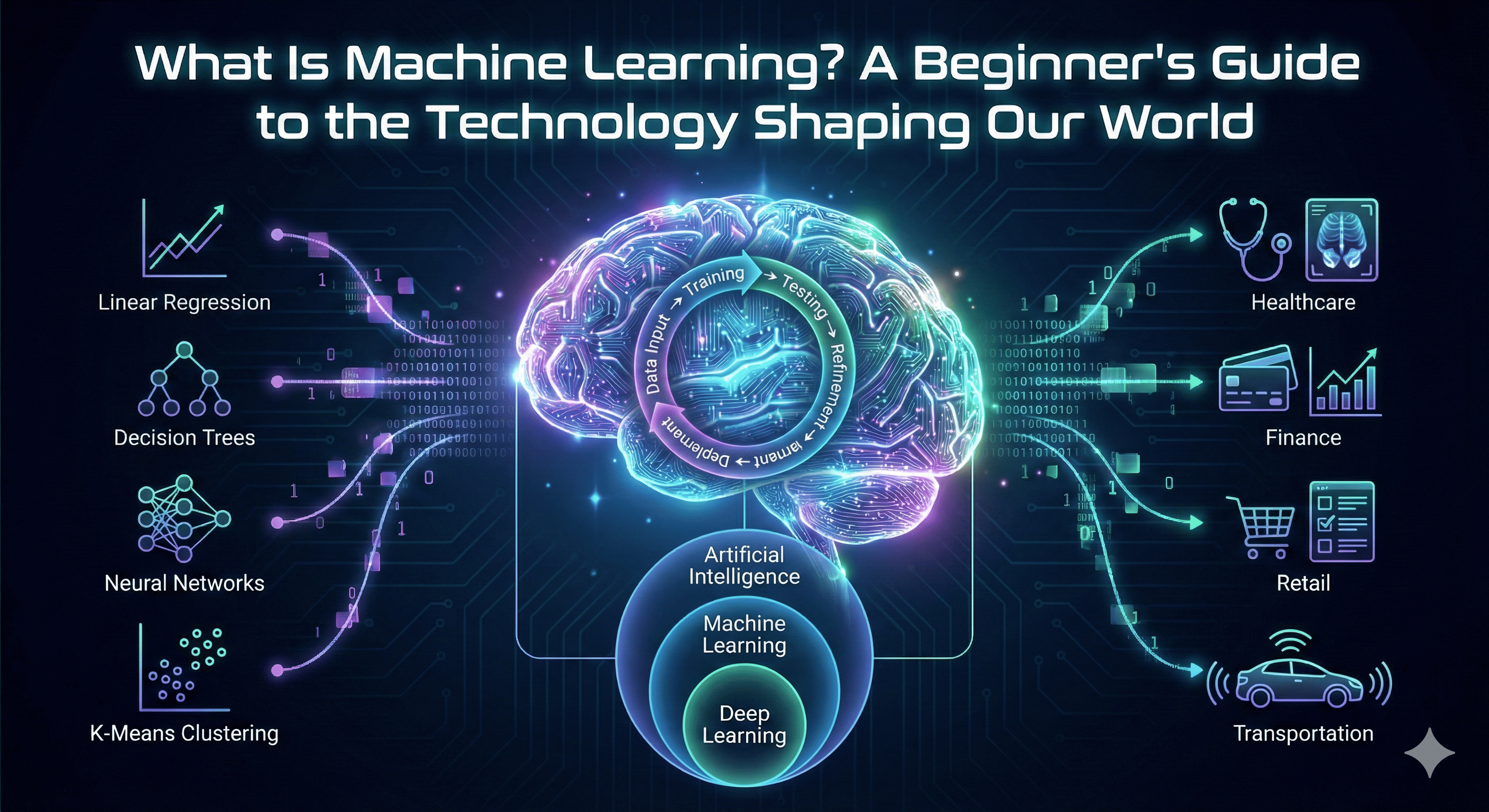
The magic of machine learning models lies in a simple feedback loop:
- Feed data in — the more, the better.
- Train the model — the algorithm finds patterns within the data.
- Test and evaluate — how accurate are the predictions?
- Refine and deploy — the model improves over time with more data.
This is fundamentally different from traditional programming, where every rule must be hand-coded. In ML, the system writes its own rules — from the data up.
The Building Blocks: Machine Learning Algorithms
Machine learning algorithms are the mathematical engines that power this learning process. Some of the most widely used include:
- Linear Regression — predicts continuous values (e.g., house prices).
- Decision Trees — makes decisions by branching through a series of yes/no questions.
- Neural Networks — loosely inspired by the human brain; the backbone of deep learning.
- Support Vector Machines (SVM) — classifies data by finding the best boundary between categories.
- K-Means Clustering — groups similar data points together without labeled examples.
Each algorithm is suited to different types of problems, and choosing the right one is part of the craft of being a skilled machine learning engineer.
What Is Machine Learning Used For?
The question of what machine learning is used for has almost too many answers. Here's a snapshot across industries:
Healthcare — Detecting tumors in medical scans with higher accuracy than human radiologists. Predicting patient readmission risks. Accelerating drug discovery.
Finance — Fraud detection in real time. Algorithmic trading. Credit scoring models that assess risk more fairly.
Retail & E-commerce — Personalized product recommendations (hello, "you might also like..."). Inventory forecasting. Dynamic pricing.
Transportation — Self-driving vehicles use ML to interpret sensor data and navigate roads. Ride-sharing apps predict demand surges.
Natural Language Processing (NLP) — Powering chatbots, translation tools, and voice assistants that understand and generate human language.
Cybersecurity — Identifying anomalous network behavior before a breach occurs.
The truth is, there are very few industries not being transformed by AI and machine learning right now.
AI Machine Learning: The Relationship Explained
The terms AI machine learning and machine learning AI are often used interchangeably in everyday conversation — and that's largely fine. In technical circles, the hierarchy looks like this:
Artificial Intelligence ⊃ Machine Learning ⊃ Deep Learning
Machine learning is a subset of AI. Deep learning (which uses large neural networks) is a subset of machine learning. When you hear about the large language models behind today's most impressive AI tools, you're hearing about deep learning — the most advanced frontier of the ML family.
What Does a Machine Learning Engineer Do?
A machine learning engineer sits at the intersection of software engineering and data science. Their responsibilities typically include:
- Collecting, cleaning, and preparing large datasets.
- Selecting and designing appropriate ML models and algorithms.
- Training, validating, and fine-tuning models for performance.
- Deploying models into production systems at scale.
- Monitoring model behavior over time and retraining as needed.
It's one of the most in-demand roles in tech today, combining strong programming skills (especially Python), statistical knowledge, and a deep understanding of how machine learning models behave in the real world.
Machine Learning News: What's Happening Right Now?
The field of machine learning is evolving at a breathtaking pace. Some of the biggest trends defining the current era include:
Generative AI — Models like large language models and image generators have brought ML into the mainstream, sparking global conversations about creativity, authorship, and the future of work.
Multimodal Models — The latest systems can process text, images, audio, and video simultaneously — understanding the world more like humans do.
AI Regulation — Governments worldwide are drafting frameworks to govern the use of AI and ML, particularly around bias, transparency, and accountability.
Edge AI — Running machine learning models directly on devices (phones, IoT sensors) rather than the cloud, enabling faster and more private AI.
AutoML — Tools that automate the process of selecting and tuning models, making ML accessible to non-experts.
Staying current with machine learning news has become essential not just for engineers and researchers, but for business leaders, policymakers, and curious citizens alike.
The Challenges Ahead
Machine learning is powerful, but it's not without its challenges:
- Bias — Models trained on biased data can perpetuate and amplify discrimination.
- Explainability — Complex models (especially deep neural networks) often function as "black boxes," making it hard to understand why they make specific decisions.
- Data privacy — Training powerful models requires vast amounts of data, raising serious privacy concerns.
- Energy consumption — Training large models is computationally expensive and environmentally demanding.
These challenges make responsible development of AI and machine learning one of the most important conversations of our time.
Final Thoughts
Machine learning is not a futuristic concept — it's embedded in the products and systems you use every day. It's the reason your email filters spam, your phone recognizes your face, and your streaming service knows what to suggest next.
Understanding the basics of how machine learning models and machine learning algorithms work is no longer just for engineers. As this technology reshapes healthcare, finance, education, and beyond, a foundational literacy in ML is becoming a valuable skill for everyone.
Whether you're curious about a career as a machine learning engineer, keeping up with the latest machine learning news, or simply trying to make sense of our AI-driven world — the journey starts with asking the right question.
And you already did: What is machine learning?
Want to go deeper? Explore topics like supervised vs. unsupervised learning, how neural networks are trained, or the ethical dimensions of AI and machine learning. The rabbit hole is deep — and endlessly fascinating.